If you've typed "how to land smoothly in MSFS" into a search bar at 11pm after your fourth hard arrival in a row, you're not alone. It's one of the most searched landing problems there is, and almost every bad landing traces back to one of three faults: floating, bouncing or ballooning. Fix those and the smooth touchdown mostly takes care of itself.
Most bad landings are decided before you're near the runway
A landing that goes wrong on short final usually went wrong three miles out. If your airspeed and configuration are still changing as you cross the threshold, you're reacting instead of flying, and reacting under pressure is where floats, bounces and balloons all come from. The fix is a stabilised approach: speed set, flaps out in stages, trimmed, and settled onto the correct glidepath well before you're over the numbers. In a typical Cessna 172 that means slowing down and starting flap extension on the base-to-final turn, not after it, so that by short final nothing is still moving except the aircraft.
Pitch and power do different jobs here. Use pitch to hold your target approach speed and power to control the descent path: add a touch of throttle if you're going to land short, ease it back if you're going to overshoot. Chasing both with the same control is how a stable approach turns into a scramble.
Read the aiming point, not the runway
Pick a spot on the runway, the numbers or the first stripe, and watch where it sits in your windscreen. If it climbs up the screen, you're going to land short. If it slides down, you're going to float past it. If it stays fixed, your glidepath is exactly where it needs to be. This single trick does more for a consistent approach than any amount of fiddling with the yoke, because it turns "am I too high or too low" into something you can see rather than guess.
- SpeedSET EARLY
- FlapsIN STAGES, FROM THE BASE-TO-FINAL TURN
- TrimSET
- PitchHOLDS THE SPEED
- PowerHOLDS THE PATH
- Aiming pointFIXED IN THE WINDSCREEN
The round-out and flare
Close to the runway, a matter of feet rather than a long glide, ease the power back and let the descent rate soften. That's the round-out. Then shift your eyes to the far end of the runway and raise the nose slightly to arrest the last bit of sink, letting the main wheels touch down first with the nose still up. That's the flare. It's a small, progressive movement, not a big pull, and it's the step most beginners either do too early, too late, or too aggressively.
Fixing the three classic faults
Floating, where the aircraft refuses to touch down and eats up runway, is almost always excess speed. Ten to fifteen knots too fast on a light GA type is enough to keep it flying in ground effect well past where it should have landed. The fix isn't a bigger flare, it's a slower, better-stabilised approach in the first place.
Bouncing happens when you flare too late or too hard, arrive with more sink rate than the flare absorbed, and the aircraft rejects the ground and pops back up. If it's a small bounce, hold your attitude and let it settle rather than shoving the nose down, which usually turns one bounce into a worse second one.
Ballooning is the opposite: you flare too much and the aircraft climbs slightly instead of touching down. Resist the urge to correct by pushing forward: that's how a balloon becomes a hard landing. Hold what you've got, let the speed bleed off, and let it settle gently.
In all three cases, the aiming point and a stabilised final approach fix more of the problem than adjusting the flare itself. Get to short final at the right speed, in the right configuration, on the right glidepath, and the flare only has to do a small job.
- FloatingSLOWER, STABLE APPROACH
- BouncingHOLD THE ATTITUDE, LET IT SETTLE
- BallooningHOLD IT, LET THE SPEED BLEED OFF
- Still fast, high or fiddling with flapsGO AROUND
Know when to go around
If you're still fast, still high, or still fiddling with flaps as the runway arrives, the correct move is a go-around, not a save. Real GA pilots go around often; it's routine flying, not a failure. Full power, arrest the descent, establish a climb, and retract flaps in stages rather than all at once. Practising go-arounds deliberately, not just when a landing's already gone wrong, is one of the fastest ways to stop tensing up on approach, because you know there's always an exit.
Practice with one aircraft at a time
Every type has its own approach speeds and flap schedule, and trying to remember all of them at once is part of what causes rushed, unstable approaches. Learning one aircraft's numbers properly before moving to the next is worth more than an hour of random landings across five different types. It's the same reason a written checklist earns its keep: the numbers are in front of you rather than half-remembered on short final.
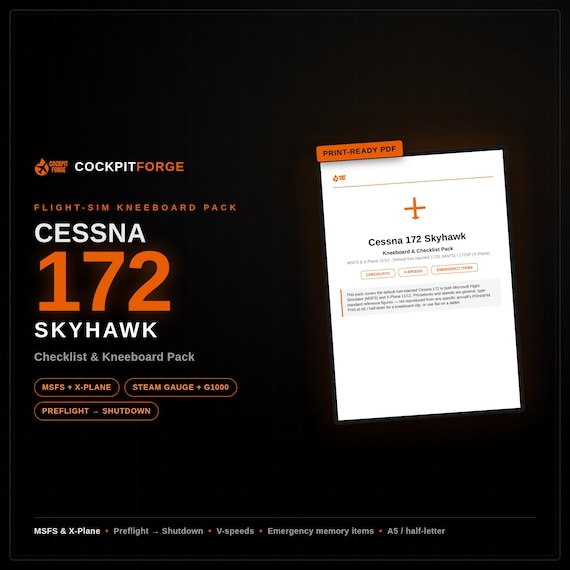
If you're working through this on the Cessna 152 or 172, our checklist and kneeboard packs lay out the approach speeds and flap flow for both, so the numbers are on your kneeboard rather than in your head.