Knowing how to do a go-around in MSFS is the quickest way to stop forcing bad landings. Most simmers treat one as an admission that the approach went wrong. In real flying it is a routine procedure with a defined sequence, and the pilots who use it early are the ones who rarely end up with a bent nosewheel. This post covers when to call it, what to do in what order, and the mistakes that turn a simple climb-out into a stall.
When to call it
Decide before you're committed. Common triggers on a light GA approach:
- You're not stable by about 500 ft above the ground: speed wandering, flaps still moving, descent rate high.
- You're a long way past your aiming point and still well above the runway.
- The runway isn't clear, or something else is on it.
- A gust has put you in a position you don't like: bounced, ballooned or drifting off the centreline.
- You simply don't feel in control of the aircraft.
The last one counts. If you're asking whether to go around, the answer is almost always yes. Pick a gate in your head ("if I'm not stable by 300 ft, I go") and stick to it. The decision is much easier when you made it five minutes ago.
The sequence, in order
Exact numbers belong to the aircraft's pilot's operating handbook (POH), but the shape is the same on every light single:
- Power: full, smoothly. Push the throttle all the way in. Don't slam it, since a sudden power change on a single-engine aircraft swings the nose.
- Carb heat cold if the type has it, so you have full power available.
- Pitch: stop the descent, then climb. Raise the nose to a climb attitude. With full power and flaps out, the nose wants to rise on its own, so expect to hold forward pressure or trim against it.
- Flaps: partially up, not all at once. Pulling full flaps up at low speed makes the aircraft sink. In the Cessna 172, the usual drill is to reduce flaps to the first stage straight away, then retract the rest once you're climbing and clear of obstacles. Check your own aircraft's handbook for the stages.
- Positive rate, then speed. Wait for a positive climb on the vertical speed indicator before you touch the flaps further. Hold the best-rate-of-climb speed (Vy) or the speed your POH gives for a balked landing.
- Track the runway. Stay on the extended centreline while you climb, and keep clear of anything that might be on the runway beneath you.
On a kneeboard, the same sequence fits on one card:
- PowerFULL, SMOOTHLY
- Carb heatCOLD, IF FITTED
- PitchCLIMB ATTITUDE
- FlapsFIRST STAGE UP
- Positive rateCHECK, HOLD VY
- TrackEXTENDED CENTRELINE
Then you fly the circuit again. If you need a refresher on that, our guide to flying the traffic pattern covers each leg.
The mistakes that cause trouble
Raising the nose too far. Full power plus a big pitch-up with flaps extended is a recipe for a slow, nose-high aircraft close to the stall. Aim for a steady climb at the target speed, not the steepest angle you can manage.
Retracting the flaps first. It feels natural to clean the aircraft up, but flaps are doing a lot of work at approach speed. Take them out in stages, once the climb is established.
Going around too late. The later you leave it, the less margin you have. A go-around from 300 ft is routine. A go-around from the flare, with the main wheels already kissing the runway, is harder, though still correct if the landing is going wrong. Full power, nose attitude held and climb away.
Forgetting to trim. Approach trim is set for a low-power descent. When you add full power, the nose rises and you'll be fighting the yoke until you re-trim for the climb.
Not telling ATC. If you're flying online or with ATC enabled, say "going around" on the radio so the controller knows what you're doing.
Practise it on purpose
Do some go-arounds when nothing has gone wrong. Set up a normal approach in a Cessna 172 or 152, and at 200 ft call it. Run the sequence, fly the circuit, and do it again. After three or four repeats the sequence is automatic, and a go-around stops feeling like failure. It becomes a normal option on the approach, and you'll find your landings improve because you're no longer trying to rescue approaches that were never going to work.
Do it at different weights and flap settings too. A go-around with full flaps in a 172 behaves differently from one with the first stage of flaps.
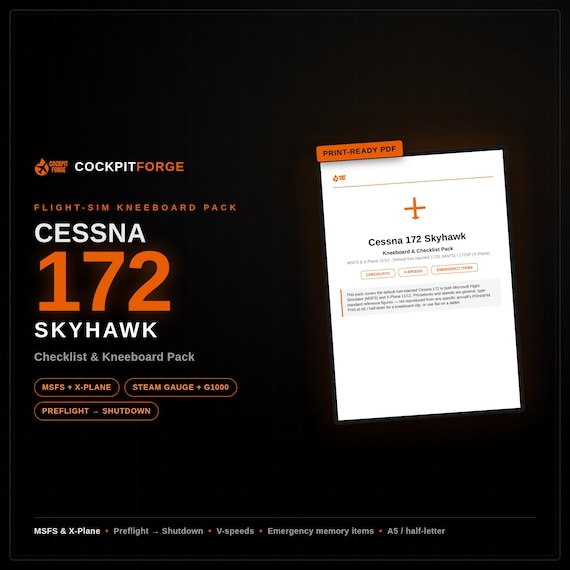
If you'd like the 172's flows and V-speeds on your kneeboard while you practise, the Cessna 172 checklist pack prints at home on A5.